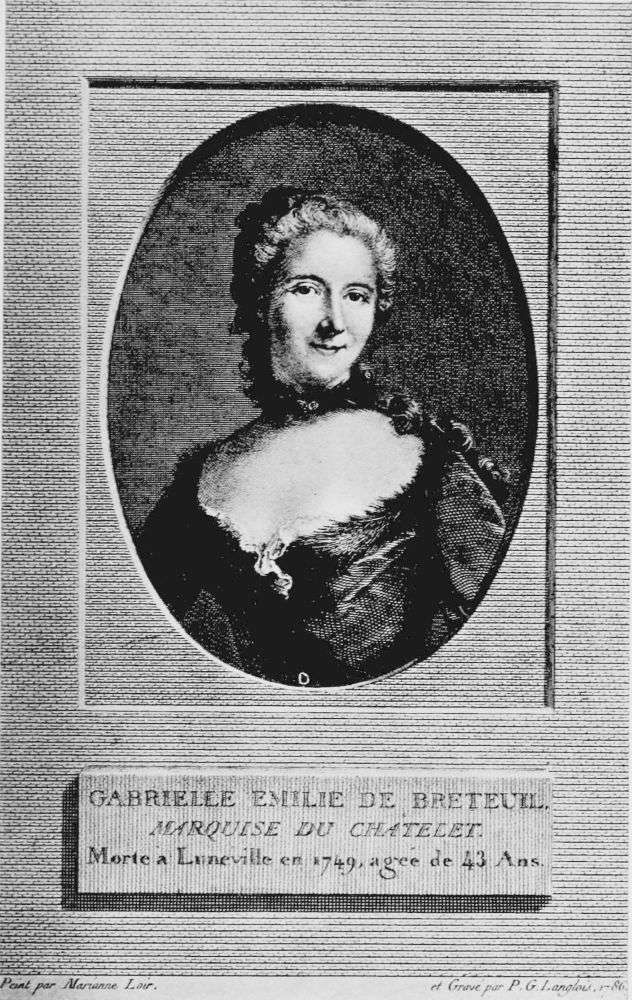
Testing hypotheses
Follow the role of hypotheses and experiment in Foundations of Physics.
An original introduction. This guide accompanies the work; it is neither the complete text nor a translation.
Situating the text
Published anonymously in 1740 and revised in 1742, the book intervenes among Newtonian, Cartesian and Leibnizian traditions. Its use of Leibniz and Wolff is an original contribution rather than mere repetition. In this textbook addressed to her son, du Châtelet presents physical principles and defends a metaphysics compatible with experimental science. Space, time, matter and motion are questions for argument rather than a list of results.
Following the arguments
Hypotheses : Explanatory hypotheses guide research when they remain answerable to phenomena and open to revision. Principles : Sufficient reason expresses a demand for explanation without replacing experimental inquiry. Living force : The measurement of motion’s effects was disputed by proponents of mv and mv².
Continuing the reading
Begin with the preface and a chapter on hypotheses; compare its reasoning with the experiments cited in the living-force dispute. Published anonymously in 1740 and revised in 1742, the book intervenes among Newtonian, Cartesian and Leibnizian traditions. Its use of Leibniz and Wolff is an original contribution rather than mere repetition.
A hypothesis becomes fruitful when it can answer to observation.
Your turn to think.
- What observation could challenge this hypothesis?
- What does the principle of sufficient reason help explain?
Your selection and progress stay in this browser.