Thirty minds.
A wider world.
From Confucius to Simone de Beauvoir, step into the lives and ideas of thirty great voices in philosophy. To understand their world. And see your own differently.
25 centuries of thought.
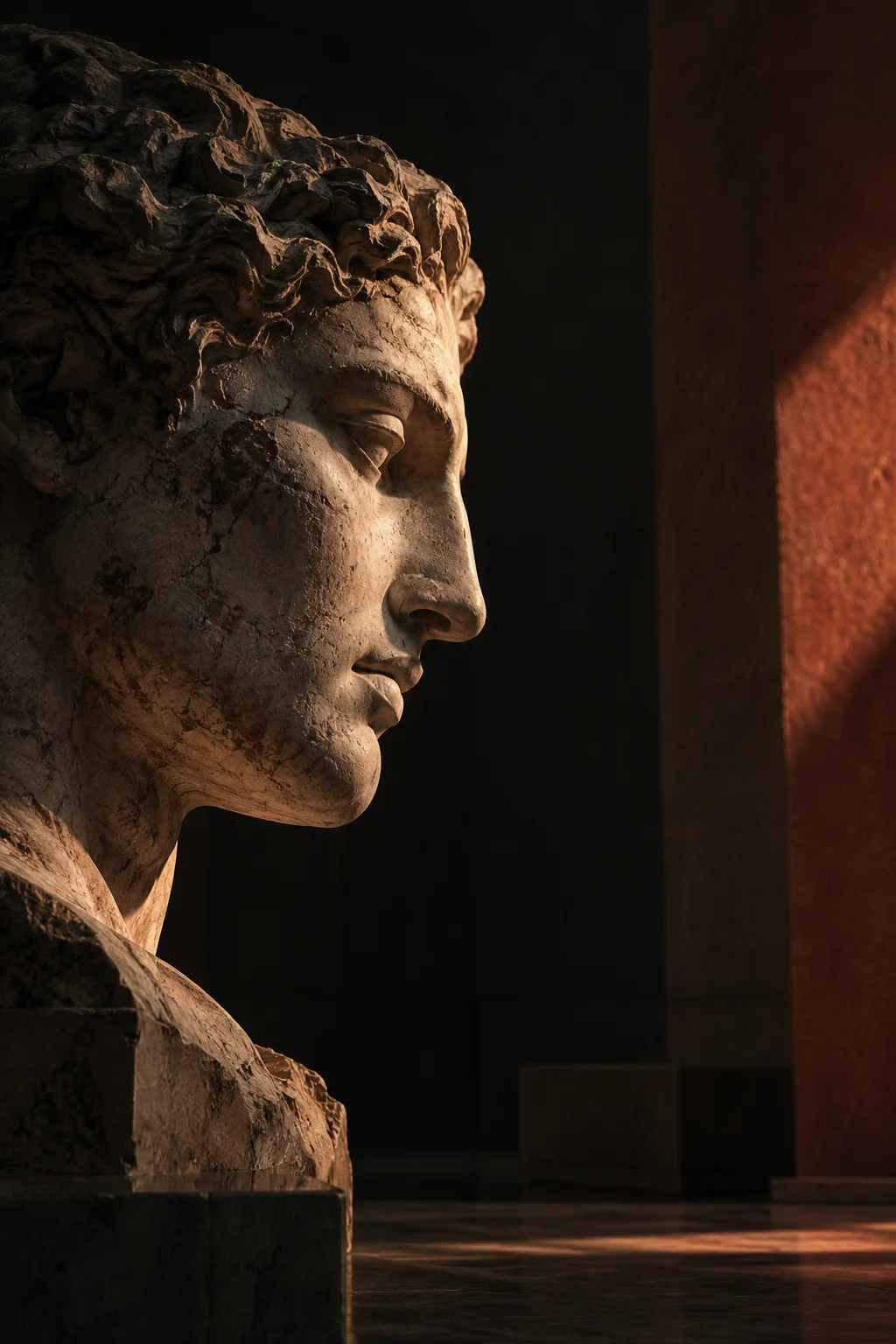 THE COLLECTION — 01 / 30
One encounter can change everything.
A name, an era, a question. Follow your curiosity.
Marcus Aurelius
An empire within.
Socrates
A question can change a life.
Plato
Learning to see beyond appearances.
Aristotle
Understanding the world. Cultivating judgement.
Confucius
Becoming human, together.
René Descartes
Dare to begin thinking again.
Baruch Spinoza
Understand what determines us.
Immanuel Kant
Question the limits of reason.
Friedrich Nietzsche
Dare to question the obvious.
Simone de Beauvoir
Freedom is built with others.
Epicurus
Learning to desire what is enough.
Seneca
Practise what you ask of life.
Epictetus
Freedom begins in judgment.
Jean-Jacques Rousseau
Understanding the dependencies that shape us.
David Hume
Examine what our habits lead us to believe.
Georg Wilhelm Friedrich Hegel
Freedom takes shape in a shared world.
Arthur Schopenhauer
Understand desire; make room for compassion.
Karl Marx
Making the relationships organizing our lives visible.
Jean-Paul Sartre
Answer for what you make of your situation.
Hannah Arendt
Make room for a shared world.
Thomas Aquinas
Reason together toward the good.
Simone Weil
See those whom force crushes.
Søren Kierkegaard
Choose without escaping uncertainty.
Laozi
Act without imposing force.
Averroes
Think with texts and their disagreements.
Heraclitus
Listen for order within change.
Pythagoras
Seek an ordered, shared life.
Émilie du Châtelet
Bring principles and experience into dialogue.
Michel Foucault
Question the assumptions that govern us.
John Locke
Know the limits of our knowledge and power.
Thirty starting points, not a ranking. An editorial collection to grow over time.
Portraits: artistic interpretationsLet curiosity lead the way.
Four routes that bring ideas into conversation. Each stop offers a perspective, a reading and a question to carry with you.
Do more than read. See differently.
Sometimes an idea deserves a pause. Save a reading, write a note, let a question find its way.
My journal